
Mandeep Lamba – President & CEO, HVS ANAROCK
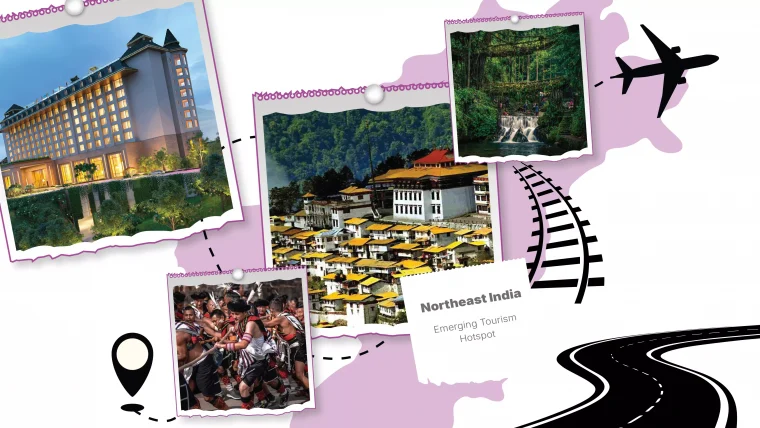
Close your eyes and picture Northeast India. Snow-dusted mountains, endless green valleys, mist curling over ancient forests, and vibrant cultures that have survived untouched for centuries. For many, it feels like a world apart, almost magical. Yet, despite this spellbinding beauty, the region remains one of India’s least explored tourism destinations.
In 2024, it accounted for just 0.43% of domestic tourist visits and 1.17% of foreign visits. It’s astonishing that a land so rich in experiences is still waiting for its time in the spotlight.
But roads are being laid, airports expanded, policies reimagined, and investors are finally noticing. Today’s travellers crave meaningful experiences—nature, culture, adventure—and the Northeast has them in abundance.
Why is tourism so low in Northeast India?
Tourism numbers historically remained low due to:
- Difficult connectivity
- Low awareness and fragmented marketing
- Perception issues around safety
- Limited branded hotels
- Disconnected policies and low private investment
But … The Narrative is Changing
Infrastructure Boost:
- Airports: Increased from 9 in 2013 to 19 operational airports in 2024. 11.2 million flyers in 2024; set to double by 2030
- Roads & Bridges: 16,000 km of roads and 2,100 bridges completed.
- Railways: 1,728 km of new tracks (2014–2024); 18 ongoing projects (1,368 km) with ₹74,972 crore investment.
Policy Reforms:
- All eight states updated tourism policies focusing on sustainability, homestays, and community-led tourism.
- Incentives include capital subsidies up to ₹5 crore, power subsidies, and single-window approvals.
Branded Hospitality Growth:
- 3,453 branded hotel keys in the region (June 2025).
- 3,096 new keys by 2030, signaling strong investor confidence.
Destination Visibility:
- Iconic festivals like Hornbill, Ziro, and Sangai attract domestic and international tourists.
Challenges are opportunities in disguise
For investors, hospitality operators, policymakers, and tourism businesses, Northeast India presents a clear opportunity:
- Eco & Sustainable Tourism: Most of these states have the largest white spaces for eco-resorts, homestays, and low-impact lodging. Sikkim and Meghalaya’s sustainability-focused policies are making eco-tourism financially compelling.
- Adventure & Outdoor Experiences: With the boost in infrastructure, improved last-mile connectivity is opening new circuits suitable for trekking, rafting, and nature-based activities.
- Tea & Plantation Tourism: While Assam is the region’s largest tea tourism market, Tripura and Arunachal Pradesh, with updated tourism policies and financial incentives, present strong prospects for organized plantation tourism.
- Cultural & Festival Tourism: With 135+ scheduled tribes across the Northeast, cultural, craft-based, and festival-led tourism remains one of the region’s strongest differentiators.
- Interstate Circuits: Multi-state itineraries—Assam + Meghalaya + Arunachal—can be developed similar to international regional circuits. This can improve average length of stay, increase spending, and strengthen the region’s competitiveness.
Conclusion
The Northeast is at a turning point.
With better roads, airports, policies, and a growing hospitality sector, it’s ready to welcome the world. For investors, travellers, and tourism stakeholders, this is a region brimming with promise, culture, and adventure.
From hidden gem to headline destination—Northeast India is ready to shine.